
English

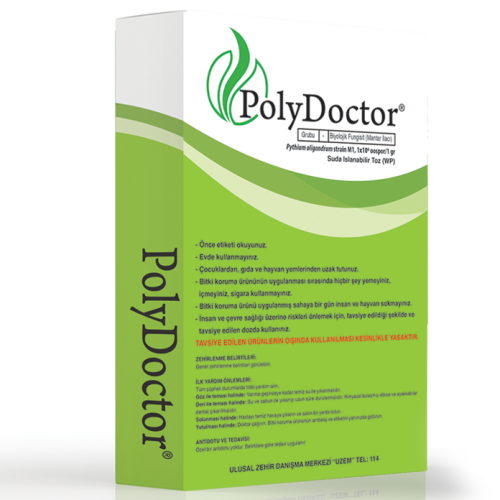
Wettable Powder (WP)
1 × 10⁶ oospores/1 g Pythium oligandrum strain M1
| Crop Name | Harmful Organism | Application Dose |
|---|---|---|
| Vineyard | Gray mold (Botrytis cinerea) | 30 g/100 L water |
| Tomato (Greenhouse) | Gray mold (Botrytis cinerea) | 25 g/100 L water |
| Cucumber (Greenhouse) | White mold of vegetables (Sclerotinia sclerotiorum) | 25 g/100 L water |
| Pepper (Greenhouse) | Damping-off and root rot of vegetable seedlings (Rhizoctonia solani, Fusarium spp.) | 25 g/da (drip irrigation) |
| Citrus | Citrus storage rot (Penicillium digitatum, Penicillium italicum) | 50 g/100 L water |
| Potato | Potato stem canker and black scurf (Rhizoctonia solani) | 30 g/1 ton of seed potatoes |
The plant protection product, calculated according to the recommended dose, is first mixed with a small amount of water in a separate container. The tank of the spraying machine is filled halfway with water. While the mixer of the machine is operating, the prepared mixture is added to the tank. Mixing is continued while the tank is filled completely with water. Continue mixing until the application is completed. Use the prepared plant protection product within the same day.
The spraying machine should be calibrated before application. The amount of mixture to be applied to a specific area should be adjusted to ensure good coverage. Applications should be carried out during the cooler hours of the day under calm or low-wind weather conditions.
Calibration of the drip irrigation system:
For calibration of the drip irrigation system, the flow rate of 3 emitters at the beginning and 3 emitters at the end of the system should be measured by operating them for 10 minutes. The deviation should not exceed the permitted limit. The amount of water required to apply the plant protection product per decare should then be determined.
Immediately after completing the application, safely empty the tank of the spraying machine. Fill the tank with clean water and operate the mixer and spraying system to ensure that all parts are thoroughly washed. Do not carry out washing operations near water sources. Do not discharge washing water or waste into water sources.
Vineyard – Gray Mold:
In the Mediterranean, Central Anatolia, Black Sea and Southeastern Anatolia Regions:
The first application should be carried out at the beginning of berry ripening. The second and subsequent applications should be carried out at 7-day intervals, taking into account the duration of effectiveness of the plant protection product.
In the Aegean, Marmara and Eastern Anatolia Regions:
The first application should be carried out immediately before flowering, the second application during the bunch closure stage, and the third and subsequent applications at 7-day intervals, taking into account the duration of effectiveness of the plant protection product.
Tomato – Gray Mold:
Application should begin when the first symptoms of the disease are observed in the surrounding area or when the plants are in the flowering stage.
Cucumber (Greenhouse) – White Mold of Vegetables:
Starting from the cotyledon leaf stage, when the plant is most susceptible to the disease, 3–4 applications at 10-day intervals are recommended, taking into account disease severity, climatic conditions and the duration of effectiveness of the product.
Pepper (Greenhouse) – Damping-off and Root Rot of Vegetable Seedlings:
For drip irrigation applications, the plant protection product is applied to the root zone after the seedlings have been transplanted into the greenhouse.
Before application, plain irrigation should be carried out to wet the root zone of the plants.
After determining the amount of water required to irrigate one decare, the required amount of plant protection product is placed in the application tank and applied through the drip irrigation system.
After application, water should continue to run for a reasonable period to flush any remaining plant protection product from the irrigation pipes.
Depending on disease severity, climatic conditions and the duration of effectiveness of the product, 3–4 applications at 10-day intervals are recommended.
Citrus – Citrus Storage Rot:
Applications are carried out after harvest in citrus processing and packing facilities using specialized automatic equipment.
If the fruit is brought to the processing and packing facility in stacks, the stacks should not exceed 3–4 rows. The fruit should be inspected immediately and any rotten fruit should be removed.
When harvested fruit arrives at the facility, rotten, bruised, physically damaged fruit and fruit that may be at risk of rotting later should be removed before any other processing takes place.
The selected fruit is then passed through calibrated automatic application units. Care should be taken to ensure complete coverage of the entire fruit surface.
The fruit should not be rinsed after treatment. It should be dried after treatment, and wet fruit should not be packed.
It is important to treat fruit as soon as possible after harvest, preferably within 12 hours.
Drenching and Spraying Method:
Fill the application equipment tank halfway with water. Mix the required amount of product with a small amount of water and add it to the tank.
With the mixing system operating, add water to the application tank until the recommended concentration is reached.
The product is then applied to the fruit by spraying or drenching.
For drencher applications, fill the machine tank with 100 liters of water and add the plant protection product at the registered dose specified on the label.
Fruit in crates is moved into the machine via a conveyor system and circulated through the system, where it is treated by drenching before exiting the system.
Dipping Method:
Fill the dipping tank halfway with water and add the recommended dose of the plant protection product. Add additional water to fill the dipping tank.
Harvested fruit is dipped into the treated water and then removed.
Approximately 5 tons of citrus fruit can be treated with 100 liters of prepared solution.
The fruit should be dried after treatment. After dipping, the fruit should be completely dried before being transferred to cold storage.
Potato – Stem Canker and Black Scurf:
Seed potatoes are spread on a flat surface.
The recommended amount of PolyDoctor (30 g) per 1 ton of seed potatoes is added to 1–1.5 L of water in a bucket, mixed thoroughly and transferred to a sprayer.
Half of the prepared mixture is first sprayed onto the seed potatoes. The potatoes are then turned over with a shovel, and the remaining half of the mixture is sprayed to complete the application.
The amount of water used should be sufficient to wet the seed potatoes thoroughly without causing runoff.
Planting immediately after application is recommended.
Rubber gloves should be worn during application, bagging and planting.
Application Using a Seed Treatment Drum (Cascade):
If a seed treatment drum is used, the recommended amount of PolyDoctor (30 g) per 1 ton of seed potatoes should first be thoroughly mixed with a sufficient amount of water in a separate container.
The mixture should then be added slowly to the treatment drum in several portions.
After each addition, the drum should be rotated to ensure that the seeds are uniformly and thoroughly coated.
Application Using Seed Treaters Equipped with an Application System:
Seed treatment should be carried out in a well-ventilated area.
PolyDoctor can be applied to the seed in a liquid misting chamber through nozzles or rotating discs using any continuously operating seed treatment machine known as a “Continuous Flow Treater.”
A preliminary test should be conducted to determine the amount of water required to provide ideal seed coverage.
The ideal amount of water is the quantity that thoroughly coats the seed without runoff, which is approximately 1.5 liters per 1 ton of seed.
Once this amount has been determined, PolyDoctor should be thoroughly mixed with the required amount of water, placed into the treatment equipment tank and applied.
Do not use muddy, wet, sprouted or otherwise unsuitable seed potatoes for planting.
Seed treatment equipment may experience problems at very low temperatures below 0°C.
PolyDoctor should be applied at temperatures above 0°C.
PolyDoctor must be used alone. Mixing it with other plant protection products is not recommended.