
English

| Crop Name | Harmful Organism | Application Dose | Time Between Last Application and Harvest |
|---|---|---|---|
| Apple | European red mite (Panonychus ulmi) | 20 ml/100 L water | 28 days |
| Apple | Two-spotted spider mite (Tetranychus urticae) | 20 ml/100 L water | 28 days |
| Apple | Hawthorn spider mite (Tetranychus viennensis) | 20 ml/100 L water | 28 days |
| Vineyard* | Two-spotted spider mite (Tetranychus urticae) | 25 ml/100 L water | 56 days |
| Eggplant, Bean, Cucumber, Gherkin | Spider mites (Tetranychus spp.) | 30 ml/100 L water | 3 days |
| Peach | Two-spotted spider mite (Tetranychus urticae) | 40 ml/100 L water | 21 days |
| Cotton | Two-spotted spider mite (Tetranychus urticae) | 40 ml/da | - |
| Soybean | Carmine spider mite (Tetranychus cinnabarinus) | 40 ml/da | - |
| Orange | Citrus red mite (Panonychus citri) | 25 ml/100 L water | 28 days |
* Not to be used in vineyard areas where grape leaves are harvested for consumption.
The plant protection product, calculated according to the recommended dose, is first mixed with a small amount of water in a separate container. The tank of the spraying machine is filled halfway with water. While the mixer is operating, the prepared mixture is added to the tank. Mixing is continued while the tank is filled completely with water. Continue mixing until the application is completed. Use the prepared mixture within the same day.
The spraying machine should be calibrated before application. The amount of mixture to be applied to a specific area should be properly adjusted to provide good coverage. Applications should be carried out during the cooler hours of the day under calm or low-wind weather conditions.
Immediately after completing the application, safely empty the tank of the spraying machine. Fill the tank with clean water and operate the mixer and spraying system to ensure that all parts are thoroughly washed. Do not perform washing operations near water sources. Do not discharge washing water or waste into water sources.
Apple – Spider mites and Hawthorn spider mite:
Starting from the beginning of May, application should be carried out when periodic counts on 100 leaves show an average of 8–10 live spider mites per leaf. Monitoring should continue at 15-day intervals after the first application until the end of August, and application should be carried out if pest density is detected.
Vineyard – Two-spotted spider mite:
Application should be carried out when the average number of live spider mites exceeds 5–8 individuals per leaf.
Eggplant, Bean, Cucumber and Gherkin – Spider mites:
In beans, application should be carried out when an average of 3 live spider mites per leaf is detected in counts made on 20 leaves. In eggplant, cucumber and gherkin, application should be carried out when an average of 5 live spider mites per leaf is detected in counts made on 10 leaves.
Peach – Two-spotted spider mite:
Starting from the beginning of May, application should be carried out when periodic counts on 100 leaves show an average of 8–10 live spider mites per leaf. Monitoring should continue at 15-day intervals after the first application until the end of August, and application should be carried out if pest density is detected.
Cotton – Two-spotted spider mite:
To determine the appropriate control time, inspections should begin when the plants have 4–6 leaves. If the pest is found only locally along the field edges or in certain areas within the field, only those areas should be treated. Application should be carried out when an average of 5 live spider mites per leaf is detected in the Mediterranean Region or 10 live spider mites per leaf in the Aegean and Southeastern Anatolia Regions.
Soybean – Carmine spider mite:
Applications should not be made after the pods have matured. Full-area application should be carried out when an average of 5 live spider mites per leaflet is detected in the Mediterranean Region or 10 live spider mites per leaflet in the Aegean Region.
Orange – Citrus red mite:
In spring, from late February to early March, mobile individuals on the upper and lower surfaces of leaves should be counted using a magnifying glass. If more than 9 live individuals are detected on 10 leaves, application should be carried out.
Application should begin before the pest moves onto fresh shoots, in other words before flowering. If this period has passed, application may also be carried out one week after fruit set. Applications should be made in the early morning.
Both the inner and outer parts of the trees and the upper and lower surfaces of the leaves should be thoroughly sprayed.
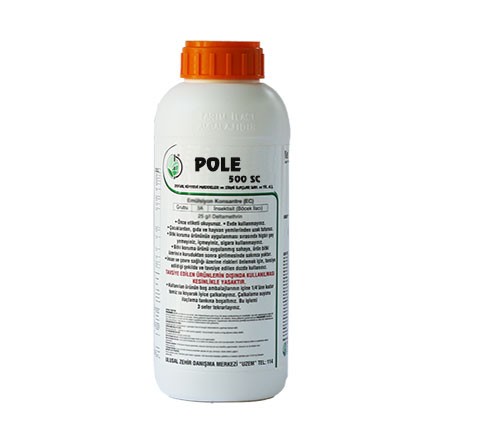
The plant protection product POLE 500 SC is an acaricide classified as Group 10A according to its mode of action.
Repeated applications of plant protection products with the same mode of action may promote the development of resistance. Therefore, in order to delay resistance development, do not exceed the total number of applications recommended for POLE 500 SC within the same production season.
If repeated application is necessary, care should be taken to use plant protection products with a different mode of action (other than Group 10A).
It is not recommended to use it in mixture with other products.
Available in 250 ml and 500 ml packages.